
Key takeaways
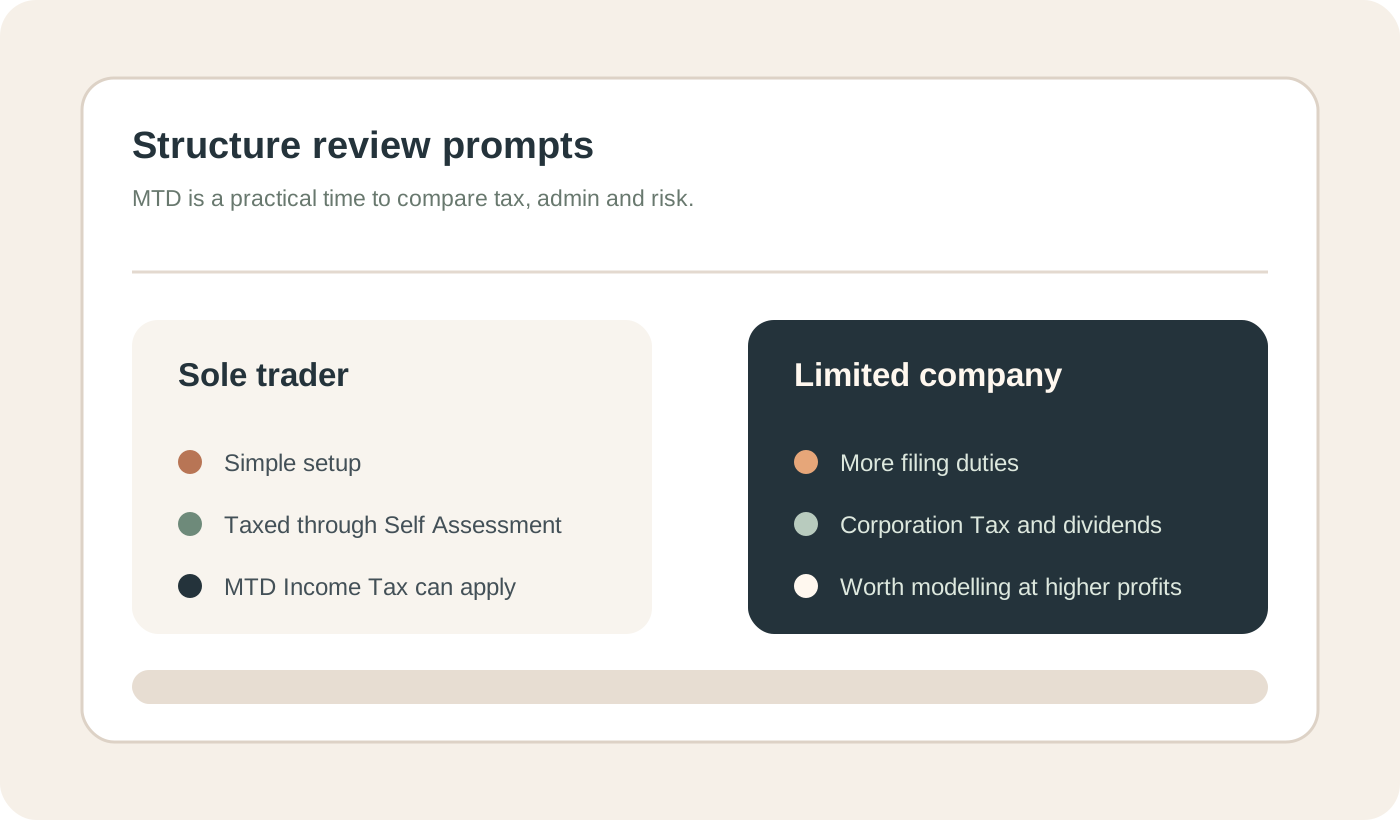
- Sole traders are simpler to run, but the owner and the business are legally the same person.
- Limited companies can be more tax-efficient at higher profit levels because dividends are not subject to National Insurance.
- Under 40,000 pounds of profit, sole trader status is often simpler and more cost-effective.
- Over 60,000 pounds of profit, a limited company is often worth serious consideration.
- Making Tax Digital has narrowed the admin gap for higher-earning sole traders from April 2026.
If you've been running your business for a while, or you're just getting started, there's one question that comes up again and again:
Should I stay a sole trader, or is it time to go limited?
It's one of the most important decisions you'll make for your business. And yet, so many people make it without the full picture. They either stay as a sole trader for too long and pay more tax than they need to, or they rush into a limited company before it actually makes sense for them.
At Aurestone Advisory, we have this conversation with clients every single week. So let's break it down: clearly, honestly, and in plain English.
First, What's the Actual Difference?
As a sole trader, you and your business are legally the same person. Your profits are your income. It's simple, quick to set up, and easy to manage. But it also means you're personally responsible if things go wrong financially.
As a limited company, your business becomes a separate legal entity registered with Companies House. The company has its own finances, its own tax obligations, and its own legal identity. This separation is what protects your personal assets.
The Big Question: How Are They Taxed Differently?
This is where it really matters.
As a sole trader, you pay:
- Income Tax on your profits, normally 20% up to 50,270 pounds, then 40% above that for basic and higher-rate taxpayers in England, Wales, and Northern Ireland
- Class 4 National Insurance at 6% on profits between 12,570 pounds and 50,270 pounds, and 2% above that
- All of this is reported through your annual Self Assessment tax return
As a limited company director, you pay:
- Corporation Tax on the company's profits, usually 19% on profits up to 50,000 pounds
- A small salary to yourself, often around the personal allowance level depending on your wider position
- Dividends on top, taxed differently from salary and with no National Insurance to pay on them
That last point is the key to the tax saving. Dividends are not subject to National Insurance. For higher earners, that difference can be thousands of pounds a year.
So When Does a Limited Company Actually Save You Money?
Here's an honest answer most people don't give you:
Under 40,000 pounds profit: sole trader is usually better. The admin costs of running a limited company, including accountant fees, Companies House filings, and payroll, often outweigh any tax saving at this level.
Between 40,000 pounds and 60,000 pounds profit: it starts to become worth looking at. This is the grey zone where a proper calculation from your accountant matters most.
Over 60,000 pounds profit: a limited company is often more tax-efficient. The savings on National Insurance alone can be significant, and you also gain the flexibility to retain profits in the company rather than taking everything out immediately.
A Real-World Example
Let's say your business makes 75,000 pounds profit this year.
As a sole trader, after Income Tax and National Insurance, you'd be taking home roughly 50,000 pounds to 52,000 pounds.
As a limited company director, taking a salary and the rest as dividends, your combined tax bill, including Corporation Tax and personal tax, could leave you with closer to 57,000 pounds to 59,000 pounds in your pocket.
That's a potential saving of 5,000 pounds to 7,000 pounds every single year. On top of that, you have the protection of limited liability.
What About the Admin?
Let's be honest: a limited company does come with more responsibility.
- Annual accounts filed with Companies House
- A Corporation Tax return, known as a CT600, submitted to HMRC
- A personal Self Assessment tax return for your salary and dividends
- Payroll to run for your director's salary
- A confirmation statement filed every year
Is the extra admin difficult?
None of this is complicated when you have the right accountant by your side. But it is more than what's required as a sole trader, where the core annual requirement is usually your Self Assessment tax return.
What About Making Tax Digital?
From April 2026, sole traders and landlords with qualifying income over 50,000 pounds are required to submit quarterly digital updates to HMRC under Making Tax Digital for Income Tax, on top of their annual tax return process. This has closed some of the simplicity gap between the two structures.
For some sole traders, this change has tipped the balance towards considering incorporation. If you're already managing quarterly reporting, a limited company starts to look more attractive from a tax efficiency perspective.
The Other Benefits of Going Limited
Beyond tax, there are real practical reasons people make the switch.
Limited liability. If your business faces a debt or legal claim, your personal assets, including your home and savings, are generally protected. As a sole trader, they are not.
Professional credibility. Some larger clients, councils, and contracts specifically prefer or require working with a limited company. It can open doors.
Easier to bring in partners or investors. A company structure makes it straightforward to issue shares and bring others in.
Pension contributions. A limited company can make employer pension contributions directly from the company, reducing Corporation Tax while building your retirement pot.
And the Downsides of Going Limited?
Your accounts are on the public record. Anyone can look up your company's filed accounts on Companies House.
Getting money out requires planning. As a sole trader, profit is simply yours. As a company director, you need to formally declare a salary or dividend. You can't just dip into the company account.
More accountability. Directors have legal responsibilities. It's not difficult, but it does need to be taken seriously.
So, Which One Is Right for You?
There's no one-size-fits-all answer. But here's a simple guide.
Stay as a sole trader if:
- Your profits are under 40,000 pounds
- You're in the early stages and still testing the business
- You want minimal admin and flexibility
Consider going limited if:
- Your profits are above 40,000 pounds to 50,000 pounds and growing
- You want to protect your personal assets
- You're looking to attract larger clients or take on staff
- You want more flexibility in how and when you pay yourself
The Aurestone Approach
At Aurestone Advisory, we don't believe in pushing anyone down one route or another. We sit with you, look at your actual numbers, understand your goals, and give you a clear, honest recommendation with real figures, not vague generalities.
Whether you're a shopkeeper in Manchester, a plumber in Birmingham, a consultant in London, or a self-employed professional building something from the ground up, this decision deserves proper thought. And you deserve an accountant who explains it in a way that actually makes sense.
Ready to Find Out Which Structure Is Right for You?
We offer a free initial review for new clients. No jargon, no pressure. Just a straight conversation about your business and what makes sense for you.
Find us on Facebook: Aurestone Advisory
Aurestone Advisory: accountancy built for our community.
This article is for general guidance only and does not constitute personal tax advice. For advice specific to your situation, please get in touch with a qualified accountant.
Making Tax Digital resource centre
Check the rule, deadline and support that applies to you
Start with the complete guide, check your quarterly dates, or see how Aurestone can manage the digital records and submissions for you.
Frequently asked questions
Is it better to be a sole trader or limited company in the UK?
It depends on your profit level, risk, admin appetite, and future plans. Sole trader status is usually simpler, while a limited company can offer tax planning flexibility and limited liability once the business is more established.
When should a sole trader consider going limited?
Many sole traders start reviewing the numbers once profits move above 40,000 pounds to 50,000 pounds, especially if profits are growing, they want limited liability, or larger clients expect a company structure.
Does a limited company always save tax?
No. At lower profit levels, the extra admin and accountancy costs can outweigh the savings. A proper calculation based on your own numbers is the safest way to decide.
Topics
Choosing between sole trader and limited company?
Get a clear recommendation based on your numbers
Aurestone can review your profit, tax position, admin needs, and business goals so you can decide whether staying sole trader or going limited makes sense.
Next step
Want help applying this to your own tax and profit numbers?
Download the free tax guide, or book a quick review if you want Aurestone to help you spot what needs attention first.